Michael Kolk interview part 2,
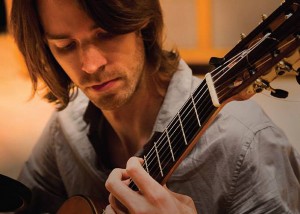
This month features Part 2 of an interview I did with the Canadian guitarist Michael Kolk earlier this spring. We discussed memorizing music and visualization.
Winner of numerous first place prizes in guitar competitions and recognized at an early age for his exceptional musicality, Michael Kolk has performed at music festivals and concert halls throughout Europe and North America.
His work with the Henderson-Kolk Guitar Duo has resulted in numerous concert appearances and two albums to date, and he has collaborated with many musicians in both classical and popular genres. He made his orchestral debut as soloist with the Toronto Philharmonia in 2011.
Originally from Vancouver, Michael currently lives and teaches in Toronto. He holds a Performer’s ARCT from the Royal Conservatory of Music, and a Master’s Degree in Guitar Performance from the University of Toronto. His first solo album Platero y Yo: An Andalusian Elegy, was released in December 2012, and his newest solo CD with Alma Records was released this year.
1. Has it always been easy for you to memorize music? What tips do you give students for memorization?
I wouldn’t say memorization has come easily to me, but I’ve figured out what I have to do and what it feels like to really have a piece firmly in my memory. Firstly, the piece has to be learned thoroughly with attention paid to smart fingerings and conscious solutions to difficult passages. It doesn’t necessarily have to be polished, but everything should be worked out. Then, I break it down into sections determined by the musical form. Depending on the length and complexity these might be the A section of a Baroque dance movement or the exposition of a sonata form, or maybe just a couple of phrases. The basic concept is to memorize manageable sections of a piece and eventually put them together. The smaller the sections, the more “reset” points you will have should you lose your way in a performance. Slow practice is very useful for memorization because it disables the muscle memory and will show you if you really know the details of what’s happening in the music. I practice at half speed to check my memory. Also, I try to hear the next notes just as I’m playing them so that it’s not just a mechanical action of the hands moving, but a real engagement in the sound of the music.
2. Do you use visualization? Can you explain what it is briefly?
Yes, visualization is a great technique that I use in many forms. On a technical level, one can practice visualizing all fingerings while hearing the music internally. If you haven’t practiced this it can be surprisingly difficult at first, but once you can hear every note and know what finger is playing it without the guitar in your hands, you will know that your memory and focus are rock solid. If there are cloudy spots you know that they may need some reviewing. Hearing a piece clearly internally is also great preparation for a performance when it’s essential to follow the musical flow and tune out both external and internal distractions. I also visualize more general things, like myself walking out on the stage and feeling relaxed and confident, or finishing a piece and feeling satisfied that it was a good performance. These things can help tremendously, as our minds are very powerful tools!
By Mariette Stephenson
http://www.mariettestephenson.com
http://www.mariettestephenson.com/calixa.html
Posted in: THE K/W GUITAR SOCIETY

 Stephen Zurakowsky Classical Guitarist